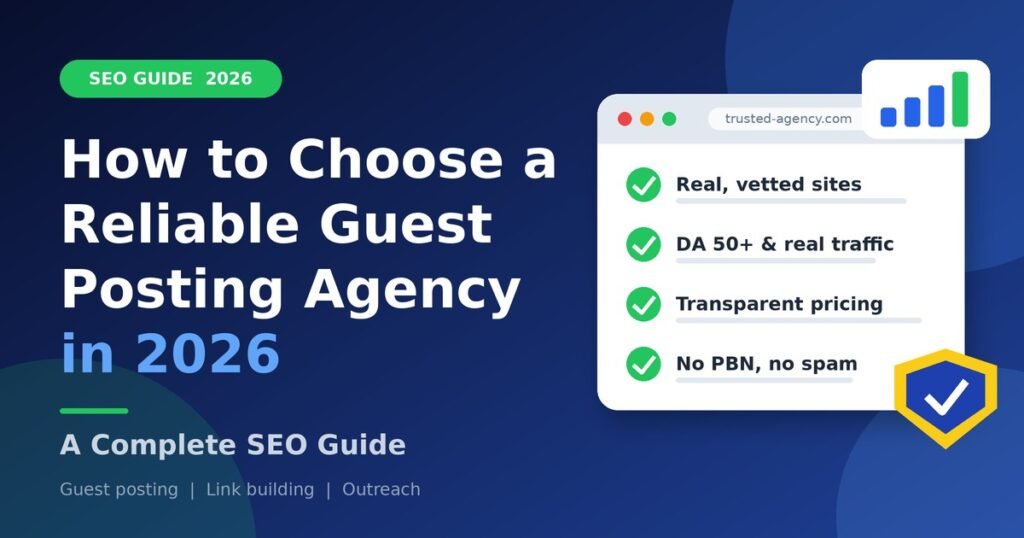
How to Choose a Reliable Guest Posting Agency in 2026: A Complete SEO Guide
 SEO Stack hub
·
Oct 5, 2026
Introduction
Choosing a guest posting agency can be difficult because providers often advertise similar benefits. Many promise quality publishers, strong backlinks, fast delivery, and improved SEO performance. Yet the services behind these claims can differ substantially.
Some companies operate open marketplaces where customers select websites and prices. Others provide managed outreach, prospect research, content production, and campaign reporting. Digital PR agencies may focus on earning editorial coverage rather than selling predefined placements.
- 100% free
- Call direct
- Voice search
- Urdu & English
Understanding these differences helps businesses avoid unsuitable services and spend their marketing budgets more carefully.
This guide explains how to compare guest posting agencies, verify website quality, assess costs, review commercial terms, and identify warning signs before placing an order.

What Does a Guest Posting Agency Do?
A guest posting agency helps businesses arrange content publication on external websites. Depending on the provider, its work may include:
- Identifying relevant publications
- Researching publishers and audiences
- Contacting editors or website owners
- Preparing article briefs
- Writing and editing content
- Coordinating publication
- Managing commercial disclosures and link attributes
- Reporting live URLs and campaign progress
Not every agency provides every service. Before purchasing a package, ask exactly what is included.
Guest Posting Agency vs. Marketplace
These two service models should not be confused.
Managed guest posting agency
A managed agency handles much of the work on your behalf. This can be useful when your team lacks time for publisher research, outreach, content preparation, and follow-up.
The trade-off is that you may have less direct control over the workflow, and managed services can cost more because they include labor and coordination.
Guest posting marketplace
A marketplace allows customers to explore listings, compare available publications, and order placements through a platform.
This can provide more visibility into inventory and pricing, but the buyer must still evaluate the quality and relevance of individual websites.
Digital PR agency
A digital PR provider focuses on stories, research, expert commentary, or other materials that may attract coverage from journalists and publications.
This model may be appropriate when the goal is brand awareness and editorial attention rather than purchasing a predefined placement.
Six Criteria for Evaluating Guest Posting Agencies
1. Topical relevance
The publication should reach an audience that has a reasonable interest in your business.
For example, a business software company may benefit from a useful article on a relevant technology or entrepreneurship website. Publishing the same article on an unrelated website simply because it has a high authority score may provide little audience value.
Ask the provider how it evaluates subject relevance and whether you can review proposed publications before approval.
2. Real audience and traffic quality
A website’s traffic should be evaluated alongside its content, audience, and history.
Where possible, review:
- Available Google Analytics information supplied by the publisher
- Search performance data supplied by the site owner
- Estimated organic traffic from independent SEO tools
- Recent content publication patterns
- Geographic relevance
- Evidence of genuine audience engagement
Third-party estimates are not equivalent to verified analytics. Treat them as useful indicators rather than definitive proof.
3. Editorial standards
A reliable provider should be able to explain how articles are reviewed and how unsuitable websites are rejected.
Ask whether the process includes originality checks, factual review, topic relevance, editorial approval, and quality control.
Be cautious when a provider accepts any article on any subject without meaningful review.
4. Transparent pricing
Understand the difference between the advertised price and the total cost.
Ask whether the quote includes writing, editing, publisher outreach, publication, images, revisions, and reporting.
Clarify whether additional fees apply to premium publications or specialized content.
5. Clear delivery and payment terms
Before ordering, confirm:
- Expected delivery timeframe
- Whether publication is guaranteed under the contract
- What happens if a publisher rejects the article
- Whether a replacement or refund is available
- Payment milestones and processing fees
- How disputes are handled
- What happens if a published page is later changed or removed
Never assume a service offers permanent publication or a refund unless the written terms support that promise.
6. Compliance and transparency
A provider should understand the difference between legitimate content marketing and paid link schemes.
Google’s guidance says paid placements should be appropriately qualified, using rel="sponsored" or rel="nofollow".
Official reference: Google Search Central: Qualify Outbound Links.
Avoid providers that promise guaranteed Google rankings, offer manipulative anchor-text packages, or refuse to explain how paid links are handled.
Guest Posting Agencies and Marketplaces Worth Comparing
The following providers illustrate different service models. They are starting points for research, not a universal ranking or a guarantee of quality.
Adsy
Official website: Adsy
Adsy provides a marketplace for discovering content placement opportunities. It may suit teams that prefer to review available websites and manage orders through a centralized platform.
When evaluating it, examine publisher details, available metrics, content requirements, and the actual cost of each placement.
WhitePress
Official website: WhitePress
WhitePress provides content placement and related marketing services with international reach.
It may be worth comparing for campaigns involving multiple countries or languages. Review its current publisher inventory and the suitability of specific sites rather than assuming that every listed publication meets your needs.
Collaborator.pro
Official website: Collaborator
Collaborator offers a platform for content placement and publisher discovery.
It can be considered when you want to compare listings and publication opportunities across different markets. Verify the website’s current metrics, editorial quality, and commercial terms before ordering.
Accessily
Official website: Accessily
Accessily provides a marketplace for connecting businesses with publishers.
Compare the platform’s available websites, listing details, workflow, and protections. As with any marketplace, assess the actual publication rather than relying only on the platform’s overall claims.
Outreach Monks
Official website: Outreach Monks
Outreach Monks represents the managed-service model, where an external provider assists with link-building and outreach activities.
It may suit teams that prefer to outsource operational work. Ask about prospect selection, content standards, reporting, and how the provider handles paid-link attributes.
Loganix
Official website: Loganix
Loganix offers SEO-related services that businesses can evaluate when comparing managed link-building solutions.
Review the scope of the service, the selection process for publications, the level of campaign transparency, and the suitability of the proposed placements for your business.
FATJOE
Official website: FATJOE
FATJOE offers content and SEO services that may be relevant to marketing teams outsourcing campaign delivery.
Before choosing a package, confirm the exact deliverables, quality checks, publication requirements, and reporting arrangements.
How Much Does Guest Posting Cost?
Pricing varies by publication, country, niche, editorial standards, and service model.
A marketplace listing may charge for an individual placement, whereas a managed agency may include research, outreach, writing, and account management in the price.
For planning purposes, consider three hypothetical budgets:
| Monthly budget | Illustrative average cost | Number of placements |
|---|---|---|
| $500 | $100 | 5 |
| $1,000 | $200 | 5 |
| $2,000 | $250 | 8 |
These are arithmetic examples, not verified market averages or recommendations to buy links for ranking manipulation. They illustrate how pricing affects the number of projects a budget can support.
A more expensive placement is not automatically better. Evaluate relevance, audience, editorial standards, and the actual service delivered.
Calculate Return on Investment Carefully
Guest posting does not have a guaranteed financial return. If you are purchasing content distribution for audience development, define what success means before launching a campaign.
Possible measures include:
- Relevant referral traffic
- Brand mentions
- Qualified leads
- Newsletter sign-ups
- Assisted conversions
- Audience engagement
- Publication quality and relevance
For example, suppose a content campaign costs $1,000 and generates 20 qualified leads. The campaign cost per lead is $50.
This does not prove that the campaign generated $50 worth of value per lead. You still need to evaluate conversion rates, customer value, and other acquisition costs.
If the objective is SEO, avoid treating purchased ranking credit as a legitimate guaranteed outcome. Focus on content quality, audience relevance, and compliance with search engine policies.

Warning Signs of an Unreliable Agency
Guaranteed ranking improvements
No agency can honestly guarantee a particular Google ranking simply by selling guest posts.
Unrealistic traffic claims
Be cautious if the provider refuses to explain its data sources or relies entirely on screenshots without context.
Irrelevant publisher networks
A website’s numerical authority score does not make it relevant to every industry.
Identical articles across unrelated websites
Large-scale distribution of repetitive content can indicate a low-quality process.
Hidden publisher identities
If you cannot see the proposed website before approval, clarify what protections and replacement terms are available.
No clear paid-link policy
A provider that refuses to discuss sponsored disclosures and link qualification creates avoidable risk.
Pressure to purchase immediately
Take time to evaluate the offer, review the contract, and compare alternatives.
A Practical Agency Evaluation Checklist
Before approving a campaign, verify the following:
-
The proposed websites are relevant to the target audience.
-
Traffic claims have a clear source.
-
The provider explains its editorial review process.
-
Pricing and deliverables are documented.
-
Publication and replacement conditions are clear.
-
Paid links are appropriately qualified.
-
Content is original, accurate, and useful.
-
Reporting includes the actual published URLs.
-
No ranking or income guarantees are being used to pressure the buyer.
If several important details remain unclear, request written answers before committing your budget.
Find and Compare Guest Posting Options on SEO Stack Hub
Once you know what to look for, the next step is comparing real options. On SEO Stack Hub you can:
- Browse verified link building and guest posting agencies, with services, budgets and reviews, in the SEO agency directory.
- Pick individual sites by niche, traffic and authority in the guest post marketplace, if you prefer to choose every placement yourself.
- Find relevant sites to pitch with the free Backlink Opportunity Finder.
- Estimate the return on a campaign with the SEO ROI Calculator.
For a ready-made shortlist, see our guides to top link building services in the United States and white-label link building agencies. Questions about a specific agency? Ask the SEO community.
Frequently Asked Questions
Which guest posting agency is best?
The right provider depends on whether you need managed outreach, direct marketplace access, or digital PR. Compare actual service terms and publication quality rather than relying on a universal ranking.
Are guest posting marketplaces cheaper than agencies?
They can provide more direct pricing and self-service control, while managed agencies include additional labor and coordination. Total costs vary by provider and campaign.
Should I choose websites with high Domain Authority?
Authority metrics can be useful for comparison, but they are not enough on their own. Topical relevance, genuine audience, content quality, and traffic history also matter.
Can guest posting guarantee better rankings?
No. Rankings depend on many factors, and paid links intended to manipulate ranking signals can violate Google’s spam policies.
What should an agency report after publication?
At a minimum, request the live URL, publication status, agreed deliverables, and any relevant reporting promised in the contract.
Is guest posting useful without dofollow links?
Yes. Relevant articles can support brand visibility, referral traffic, expert positioning, and audience development. The value of a placement should not be judged only by its link attribute.
Conclusion
Choosing a reliable guest posting agency requires careful evaluation of its service model, publication quality, pricing, reporting, and commercial terms.
Marketplaces such as Adsy, WhitePress, Collaborator.pro, and Accessily provide places to research publishing opportunities. Managed providers such as Outreach Monks, Loganix, and FATJOE represent a different approach, with more emphasis on outsourced campaign execution.
Regardless of the provider, review individual websites, check the audience, insist on clear terms, and ensure paid links are handled appropriately.
A thoughtful content strategy prioritizes relevant audiences, useful information, and long-term credibility over quick promises about rankings.